Myths About Name Changes at Ellis Island
Why your family's name wasn't changed at Ellis Island, what actually happened, and how to trace name variations across records.
Your family name is Judecy. You have always been told it was Giudice in Italy. The explanation is simple and familiar: when your ancestor arrived, someone at Ellis Island heard an Italian name, spelled it the best they could, and that spelling stuck.
Stories like this are common in Italian-American families, and the name change itself was real. But the place and the mechanism are wrong. Every major historian who has studied Ellis Island, every government archive that holds the records, and the Ellis Island museum itself agree on one point: immigration officials did not change names at the port. If you are trying to connect an American surname like Judecy back to an Italian civil record, understanding where the change actually happened is the difference between progress and confusion.
The inspection process
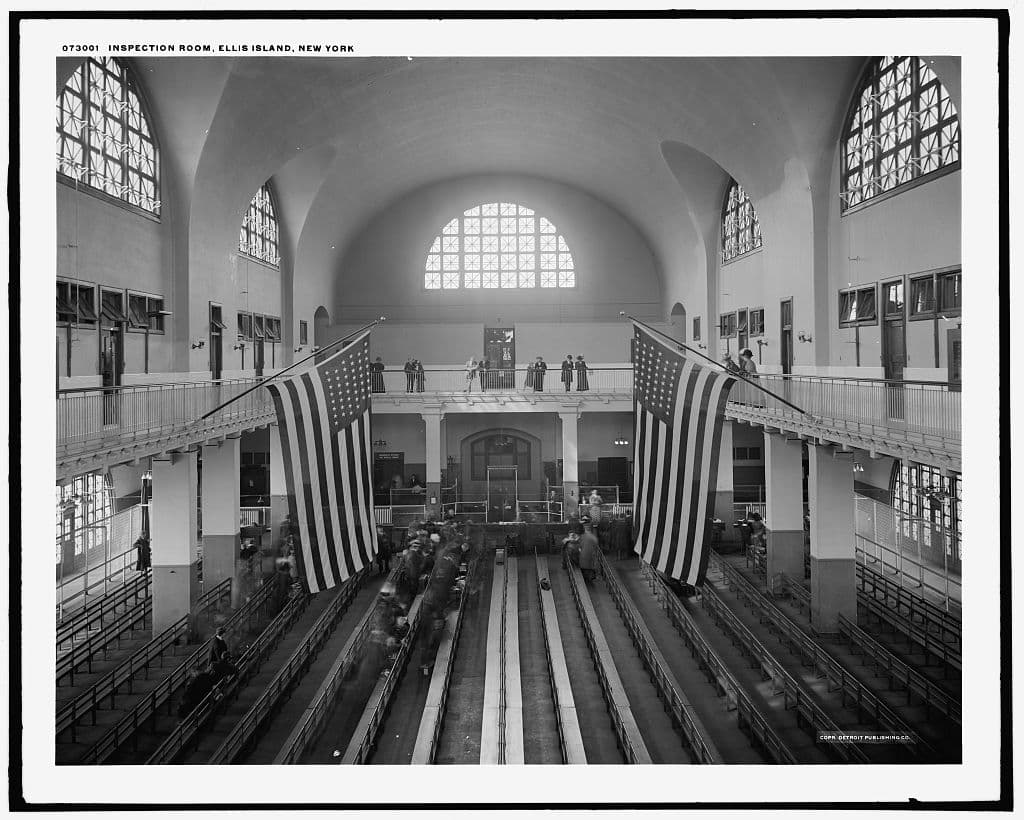
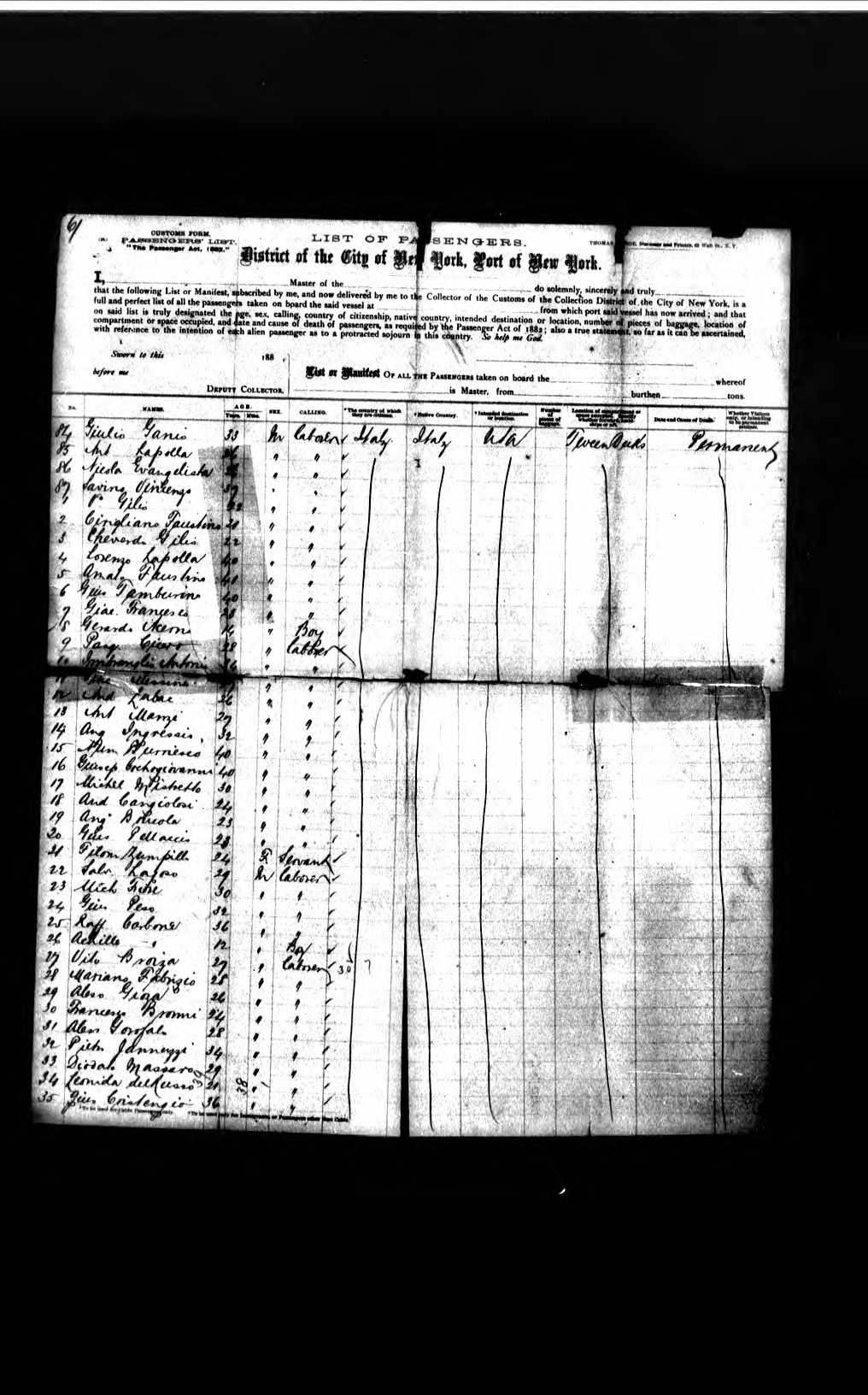
Your ancestor's name was written down before they ever boarded the ship. When an Italian emigrant bought a steamship ticket at a shipping line office in Naples, Genoa, or Palermo, a clerk copied the name from passports and exit documents onto the ship's manifest. Before boarding, a ship's doctor examined them and officials asked between 19 and 30 screening questions, depending on the decade. The answers were written onto the manifest, and each passenger received a numbered tag matching their page and line number.1
At Ellis Island, inspectors did not ask immigrants to state their names and write them down from scratch. Inspectors worked from the manifest prepared overseas. They located the matching line number and asked the same questions again to verify the information already written. Any discrepancies were marked in red ink. The inspector was checking a document, not creating one.1, 7
Immigration law expanded the amount of information collected, but not the process. From the Steerage Act of 1819 through the Immigration Acts of 1891, 1893, 1903, 1907, and 1917, passenger manifests accumulated more columns and more questions. By the peak years of immigration, manifests ran two pages with nearly thirty columns per person.4
Inspectors operated under regulations ordering them not to change names or identifying information unless the immigrant requested it or the inspection revealed an error.2 Officials were known for correcting mistakes in passenger lists, not introducing new ones.3
If Ellis Island inspectors did not create or rewrite names, then the spelling your family uses today did not originate at the inspection desk.
The staff spoke your ancestor's language
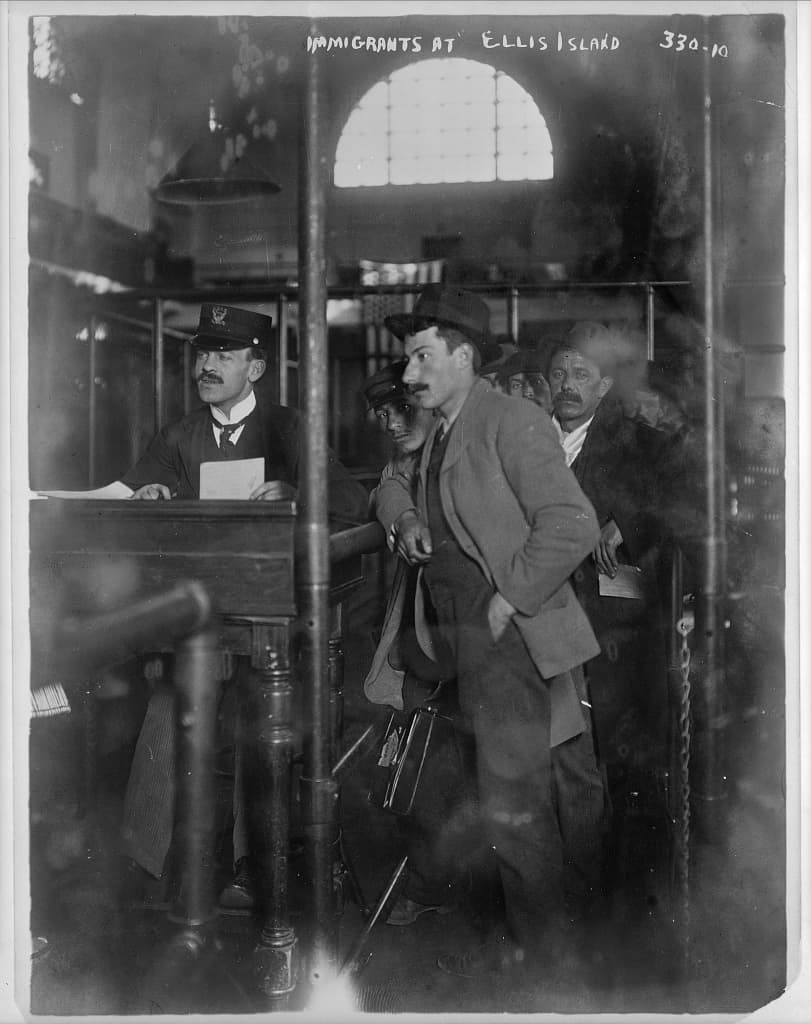
The image of a monolingual English-speaking official struggling with Italian names does not match the historical record. From 1892 to 1924, roughly one-third of immigrant inspectors were themselves foreign-born. Inspectors spoke an average of three languages. Interpreters averaged six, and fluency in a dozen languages was not unusual. About sixty languages were covered at all times.3, 6
Fiorello LaGuardia, later mayor of New York, worked as an Ellis Island interpreter from 1907 to 1910. He spoke Italian, German, Yiddish, and Croatian.6
Shipping companies paid for mistakes
Under the Immigration Act of 1891, any passenger denied entry had to be returned to their port of origin at the shipping company's expense. Companies faced fines of $100 per deported passenger, plus the cost of return passage.5 This made shipping companies the first line of immigration enforcement. A mistake on a manifest could be expensive, which is why names were recorded carefully before departure.
One exception in twelve million
There is one verified case of an Ellis Island inspector changing a name on a manifest.3
On October 4, 1908, a passenger arrived as Frank Woodhull, listed as male. Medical screening revealed that Woodhull was biologically female, born Mary Johnson, who had lived as a man for fifteen years. The inspector corrected the manifest accordingly. Out of roughly twelve million immigrants processed between 1892 and 1954, this is the only documented instance. It occurred because the original information was factually incorrect, not because an inspector simplified a foreign name.
Where the myth came from
The idea that Ellis Island officials routinely changed names does not appear in published literature until around 1970,9 sixteen years after the station closed.
Popular culture reinforced it. In The Godfather Part II, an Ellis Island official assigns the surname “Corleone” to young Vito Andolini. In Mario Puzo's novel, Vito chooses the name himself. The film turned an immigrant's choice into an official's act.
By the late 1970s, books described officials as careless with names,10 and the opening of the Ellis Island museum in 1990 cemented the story in public memory.
For many families, “Ellis Island” became shorthand for the entire early immigrant experience: learning English, finding work, adapting socially, and adjusting a name. A gradual process was compressed into a single place.2
What actually changed the names
Names did change, but not at the inspection desk. They changed in homes, workplaces, schools, and courts, over years rather than minutes.
Common law name changes. In early twentieth-century America, no formal legal procedure was required to change a name. A person could adopt a new spelling simply by using it consistently for non-fraudulent purposes.12
Workplace and social pressure. Italian surnames were often anglicized by employers, teachers, or clerks. An immigrant named Mario Giudice might find himself recorded as Judecy at work, then adopt that spelling out of convenience. Over time, the new form became the family name.13
Naturalization. After 1906, immigrants could formalize a name change during naturalization, and the records document both the original and adopted forms.16
If your family story says “Ellis Island changed it,” this is usually the part of the story that has been forgotten.
How Italian surnames changed in America
Joseph Fucilla's work documents the patterns.13 They follow linguistic rules, not bureaucratic accidents.
Loss of the final vowel, phonetic spelling, translation of meaning, and first-name substitution account for most changes. Judecy from Giudice fits squarely within these documented patterns.
How to find the original spelling
To reconnect an American surname to its Italian form, the most reliable records are those created closest to the point of departure and those that show transitions over time.
Ship manifests
The Ellis Island Passenger Database holds 65 million records of passengers and crew entering the Port of New York from 1820 to 1957. Because manifests were filled out at the port of departure, names appear in their original Italian form. An immigrant known in America as “Joseph” will appear as “Giuseppe.” Post-1906 manifests also include money carried, who they were joining in America, and a physical description.
The original New York manifests no longer exist. In January 1948, they were sold to General Waste Products, Inc. for $1,274.90 and pulped. Only microfilm copies survive at the National Archives.1
Naturalization records
After September 27, 1906, naturalization forms were standardized nationwide. They show the legal transition: the original name, any aliases used, and the name adopted as a citizen. They also include full name, date and place of birth, port and date of arrival, occupation, spouse and children's names, character witnesses, and physical description.16
Where to find them: NARA regional facilities have federal court naturalizations. USCIS holds duplicate copies of court records from September 1906 through March 1956 in C-Files, and post-April 1956 in A-Files. Pre-1906 naturalizations could happen at any “court of record,” so check county courthouses and state archives. Some records are on Ancestry.com and Fold3 (both subscription services, but free to use at NARA facilities and most public libraries).
Census records
U.S. censuses taken every 10 years provide snapshots of how a surname was spelled at different points. Different enumerators produced different spellings. The censuses that matter most for Italian immigrant research are 1900, 1910, 1920, and 1930, all of which include year of immigration or arrival. The 1920 census also includes year of naturalization. These records are available through NARA and through Ancestry, which is free at most public libraries.
Italian civil records
The Antenati portal is a free Italian government database with over 71 million digitized civil record images from 52 state archives. You can browse by province, then town, then record type (births, marriages, deaths), then year. Coverage runs from 1806 through the 1930s. Some records are indexed by name; others are browse-only. To find your ancestor's comune and request certified copies directly, use the Paese comuni directory.
Manifests typically recorded a village of origin rather than the parent comune. If the place name does not match a comune, search for it as a locality on Paese to identify which comune holds the civil records.
NYC name-change petitions
If your ancestor lived in New York, formal name-change petitions may survive in the NYC Civil Court collection, covering 1887 to 2012. The New York County Clerk Archives at 31 Chambers Street, 7th Floor, has petitions and court orders from 1848 to 1934. They are public records; anyone can access them. Indexes for records from 1896 to 1934 are in open-shelf books at 60 Centre Street, Room 103B.
No comprehensive online database exists. You would need to visit in person or hire a researcher.
Ellis Island by the numbers
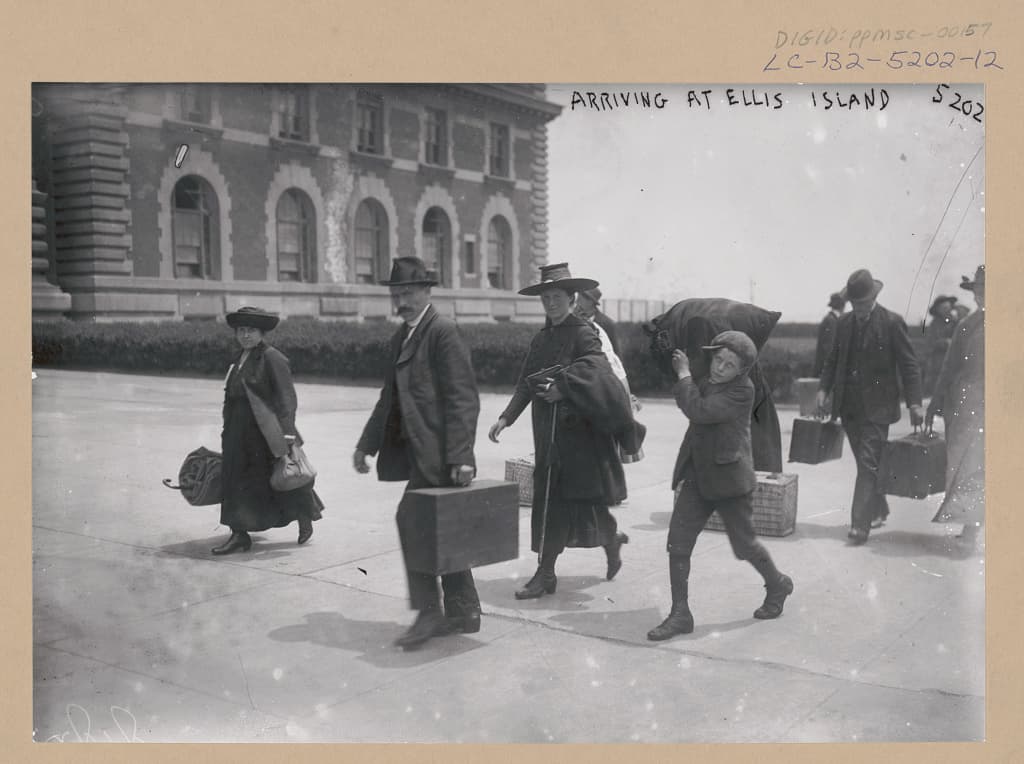
- 12 million+ immigrants processed, 1892-1954
- Peak year: 1907, with 1.25 million processed
- Busiest single day: April 17, 1907, with 11,747 people
- Daily average during peak: about 5,000 per day
- Inspector workload: 400-500 people per day during peak
- Staff: approximately 500 employees
- Processing time: 80% were through in a few hours
- Medical exam: about 6 seconds per immigrant for the initial visual screening (covering 60 symptoms)
- Rejection rate: 2%
- Detention rate: 20% (half for health reasons, half legal)
- Only steerage and third-class passengers were inspected at Ellis Island. First and second class received a cursory check aboard the ship.
Statistics from sources 7 and 15.
Sources
- Marian L. Smith, “The Creation and Destruction of Ellis Island Immigration Manifests,” Parts 1 and 2, Prologue (National Archives), Fall and Winter 1996. Part 1, Part 2.
- Marian L. Smith / USCIS, “Immigrant Name Changes,” USCIS Genealogy Notebook.
- Philip Sutton, “Why Your Family Name Was Not Changed at Ellis Island (and One That Was),” NYPL Blog, July 2, 2013.
- Rosemary L. Meszaros and Katherine A. Pennavaria, “GovDocs to the Rescue! Debunking an Immigration Myth,” DttP: Documents to the People, Vol. 46, No. 1, April 2018.
- U.S. Customs and Border Protection, “1891: Immigration Inspection Expands.”
- NPS Ellis Island, “Interpreter.”
- Vincent J. Cannato, American Passage: The History of Ellis Island, Harper, 2009.
- Kirsten Fermaglich, A Rosenberg by Any Other Name: A History of Jewish Name Changing in America, NYU Press.
- Kirsten Fermaglich, “Jewish Americans changed their names, but not at Ellis Island,” The Conversation, May 2018.
- David M. Brownstone, Irene M. Franck, and Douglass L. Brownstone, Island of Hope, Island of Tears: The Story of Those Who Entered the New World through Ellis Island, Rawson, Wade Publishers, 1979.
- Megan Smolenyak, “Names were not changed at Ellis Island,” Medium.
- National Archives NARAtions Blog, “Family History Friday: The real scoop about name changes in immigration records,” December 18, 2009.
- Joseph G. Fucilla, “The Anglicization of Italian Surnames in the United States,” American Speech, Vol. 18, No. 1, 1943.
- Joseph G. Fucilla, Our Italian Surnames, Evanston, 1949.
- Smithsonian Magazine, “Ask Smithsonian: Did Ellis Island Officials Really Change the Names of Immigrants?”, December 21, 2016.
- USCIS, “History of the Certificate of Naturalization (1906-1956).”