Italian Immigration to America
From 1876 to 1914, nearly 14 million Italians emigrated. This guide covers who left, why they left, the crossing, Ellis Island, where they settled, and the data behind it.
In the town of Sciacca, on the southern coast of Sicily, the population began to thin in the 1890s. A few dozen left each year at first, mostly laborers, farmers, and sailors. By 1898, it was 800 a year. By 1906, over a thousand. In total, more than 8,200 people from this single town appear in US passenger records from the period. Multiply that by thousands of towns across southern Italy, and you begin to understand the scale of what happened between 1876 and 1914: nearly 14 million Italians left their country.
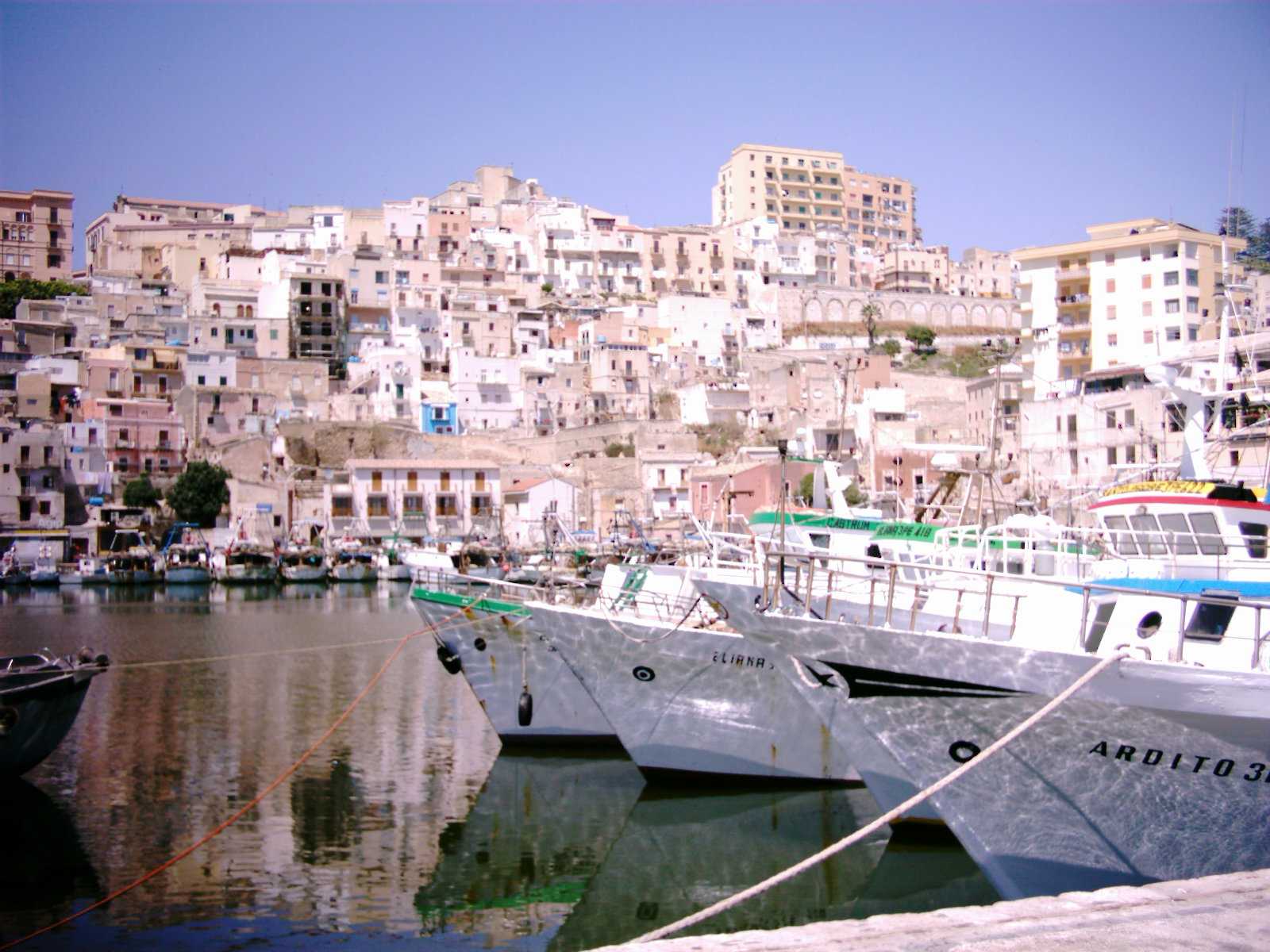
About 4 million of them came to the United States. It was the largest sustained wave of immigration from a single country in American history up to that point, and it reshaped both nations.
Before the great departure
Before Italian unification in 1861, emigration from the peninsula was small and regional. Between 1820 and 1860, approximately 14,000 Italians entered the United States: artisans from Liguria, political exiles from Piedmont, seasonal workers from the Alps.1
But Italians had been moving for centuries, just not across oceans. Shepherds from the mountains of Abruzzo walked their flocks to the Roman countryside every winter. Workers from Alpine valleys traveled south to the Piedmontese rice fields every harvest. These patterns of temporary, circular movement were deeply embedded in how Italians understood work and travel. When the Atlantic crossing became cheap enough and fast enough, the same logic applied: go where the work is, earn what you can, come home.2
Italy's emigration rate was about 5 per thousand inhabitants in 1876, the first year the new state collected systematic statistics. By 1913 it had reached 25 per thousand, one of the highest rates in Europe.3
The Great Emigration: 1876 to 1914
The numbers are difficult to absorb. According to ISTAT historical statistics, 13.9 million Italians emigrated between 1876 and 1914, to destinations across the Americas, Europe, and North Africa. Before 1900, annual departures hovered between 100,000 and 310,000. After 1900, they surged past 500,000 and kept climbing. The peak came in 1913: 872,598 people left Italy in a single year.4
Total Italian emigrants, all destinations
13.9M
1876–1914 · ISTAT Serie Storiche
In a single generation, Italy exported a quarter of its population. By 1910, roughly 14% of the country's 35 million people had emigrated at some point. Among working-age men in the south, the absence was even more dramatic.5 Entire villages were depopulated of men between 15 and 45. The women, children, and elderly who stayed behind depended on the money that came back across the ocean.
Italy was the single largest source of emigrants in Europe during this period, surpassing even Austria-Hungary and Russia in peak years. Only the British Isles produced comparable numbers relative to population.3
Who left, and from where
Italian emigration is often imagined as a purely southern phenomenon, but over the full 1876 to 1914 period, the north actually contributed a slight majority: 50.1% of all departures, versus 39.1% from the Mezzogiorno (south and islands) and 10.8% from central Italy.4
The top five emigrating regions were Veneto (1.8 million), Piemonte (1.5 million), Campania (1.5 million), Friuli-Venezia Giulia (1.4 million), and Sicilia (1.3 million). Three of the five are northern.
But the destinations diverged sharply. Northern Italians, particularly from Veneto and Friuli, went overwhelmingly to South America: the coffee plantations of Brazil, the pampas of Argentina. Southern Italians went to the United States. In the NARA passenger records covering US arrivals from 1830 to 1912, every single one of the top twenty provinces by arrival count is in the Mezzogiorno.6
The province of Palermo alone accounts for over 102,000 matched passenger arrivals. Salerno follows at 66,000, then Avellino, Napoli, Cosenza, Caserta, Messina, Potenza. Roll those provinces up to their regions and a clear pattern emerges: Campania, Sicily, Calabria, Basilicata, Abruzzi-Molise. The geography of Italian America was written in the south.
The composition also shifted over time. Before 1900, northern regions dominated total emigration. After 1900, the Mezzogiorno took over, particularly in the stream bound for America.2 7
Why they left
The causes were structural, not incidental. Southern Italy after unification was locked in a pattern of rural poverty that the new national government failed to address and in some cases made worse.
The latifondo system concentrated land ownership in large feudal estates across the south. Peasants worked as day laborers or sharecroppers with no realistic path to owning land themselves. The Inchiesta agraria Jacini, a parliamentary inquiry conducted between 1877 and 1884, documented conditions across rural Italy and found the south especially severe: crushing debt, fragmented plots too small to sustain a family, wages that could not keep pace with rents and taxes.8
Unification brought new national taxes that fell hardest on the people least able to pay. The tassa sul macinato (milling tax), levied from 1868 to 1884, was a tax on grinding grain: a tax on bread, in effect, paid by the poorest. Italian politicians of the period explicitly connected the tax burden to rising emigration.9
Then the agricultural crisis of the 1880s and 1890s hit. Global grain prices collapsed, undercutting the already marginal livelihoods of southern smallholders. Phylloxera destroyed vineyards. Cholera epidemics, particularly the severe 1884 to 1885 outbreak in Naples, compounded the sense that the state could not or would not protect its poorest citizens. In Sicily, the sulfur mining industry entered a prolonged crisis as global competition reduced demand, and displaced miners joined the emigrant stream.2 10
None of this was a single catastrophe. It was a grinding accumulation of poverty, instability, and neglect that made staying harder than leaving.
Why America
The United States between 1880 and 1910 was building at an enormous scale: railroads, subways, reservoirs, bridges, tenement blocks, coal mines. All of it demanded cheap, physically demanding labor, and Italian immigrants filled that demand.11
The wage differential was the primary driver. An unskilled laborer in the American Northeast could earn in a day what a southern Italian agricultural worker earned in a week. This is documented in both Italian government reports and the US Dillingham Commission investigation of 1911.10 11
The padrone system greased the machinery. Italian labor brokers recruited workers in Italian villages, arranged their passage, and delivered them to American employers. It was efficient and often exploitative: congressional investigations as early as 1893 documented debt peonage and wage theft within the system.11 12
But the most powerful pull was chain migration: the letter home. Once the first man from a village established himself in an American city, he wrote to his brother, his cousin, his neighbor. He told them where to go, who to see, what work was available. They followed him to the same city, the same neighborhood, sometimes the same building. Donna Gabaccia's analysis of Italian migration networks shows how village-level ties determined not just whether people left but exactly where they ended up.2
Steamship companies accelerated the process, posting advertisements in Italian towns and collaborating with emigration agents. Mark Choate documents how the Italian government and shipping firms together built an infrastructure of emigration, including dedicated remittance services through the Banco di Napoli so that earnings could flow back to families in Italy.9
The crossing
In the mid-nineteenth century, a transatlantic crossing under sail took four to eight weeks. By the 1890s, steam-powered vessels had cut the journey from Naples to New York to seven to fourteen days.2
Early Italian emigrants often departed from French ports: Le Havre, Marseille. As Italy developed its own emigration infrastructure, Naples, Genoa, and Palermo became the dominant departure points.4
Most traveled in steerage, the cheapest class. The Dillingham Commission sent undercover agents on the Naples-to-New York route and documented what they found: hundreds of passengers packed into the lowest decks, limited ventilation, no privacy, bunks stacked three high. Seasickness was universal. The food was basic and sometimes inedible. For seven to fourteen days, this was home.13
Ellis Island
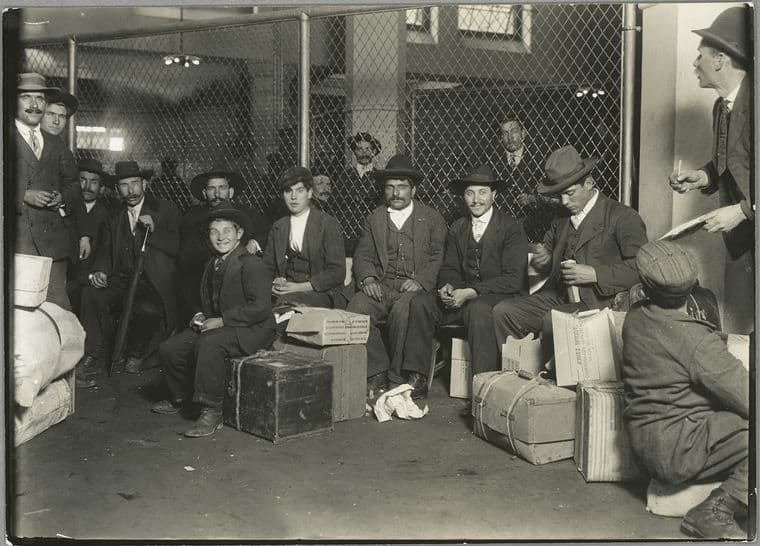
Ellis Island opened on January 1, 1892, and processed the majority of immigrants arriving in New York Harbor until it closed in 1954. Its busiest single day was April 17, 1907, when 11,747 immigrants were processed.
The experience was faster than most people imagine. A brief medical examination, including the well-known "six-second" visual inspection for signs of disease. Then legal questioning based on information from the ship manifest: name, age, occupation, destination, who was meeting them, how much money they carried. About 80% of all immigrants were processed and released within a few hours.14
Rejection rates were low. In fiscal year 1907, the peak year for Italian arrivals, 285,731 Italians arrived at US ports and 3,423 were debarred: a rejection rate of 1.2%, below the overall average of about 2%. The primary grounds for exclusion were "Likely to become a Public Charge" (LPC) and contagious diseases, particularly trachoma, an eye infection that was grounds for automatic deportation.15
For the vast majority, Ellis Island was not an ordeal. It was a few hours of confusion and anxiety, and then they were in America.
Where they settled
Italian immigrants concentrated in the urban Northeast. The 1910 Census shows the largest Italian-born populations in New York, Pennsylvania, New Jersey, Massachusetts, and Connecticut. About 90% settled in just eleven states.16
Within those cities, they formed dense neighborhoods organized not just by nationality but by village of origin. New York's Mulberry Street, East Harlem, the blocks around 115th Street where Robert Orsi documented a community transplanted almost intact from southern Italian villages. Boston's North End. Philadelphia's South Philly. Chicago's Near West Side. One block might be almost entirely families from a single province, even a single comune.17
Some regional patterns were distinctive. Sicilians settled in large numbers in New Orleans, drawn to the fruit trade and dockwork. Northern Italians, particularly from Piedmont and Liguria, settled in California and established vineyards and agricultural enterprises. These patterns were not random. They followed the chain migration networks that connected specific Italian places to specific American ones: a fishing village in Sicily to a block in the French Quarter, a hill town in Campania to a tenement on Elizabeth Street.7
The birds of passage
Here is the fact that surprises most people: a large share of Italian immigrants to the United States went home. They were called uccelli di passaggio, birds of passage. They came to work, save money, and return to Italy. The plan was never to stay. The plan was to earn enough to buy land, build a house, pay off debts, start a small business back in the village they had never really left in their minds.
Massimo Livi Bacci's analysis of official Italian statistics gives decade-by-decade return rates: 43% in the 1880s, 48% in the 1890s, 53% in the 1900s, and 63% in the 1910s. By the peak decade, nearly two out of three Italian emigrants returned to Italy.18
These rates were higher than almost any other European immigrant group. A recent synthesis of the literature concludes that between 1900 and 1920, Italians were "the group most actively engaged in return migration" among major European emigrant streams.19
The economic impact on Italy was real. Emigrant remittances averaged roughly 2.7% of Italian GDP between 1876 and 1913, with higher levels during the peak years around 1900 to 1913. For many southern villages, American wages were the single largest source of outside income.10 9
Hostility and restriction
Italian immigrants faced sustained hostility in America. They were portrayed in newspapers as criminal, diseased, and racially inferior. They occupied an unstable position in the country's racial hierarchy: legally classified as white, but often treated as something less.20
The most violent expression of this hostility came in New Orleans on March 14, 1891. After the acquittal of several Italian immigrants charged with the murder of police chief David Hennessy, a mob of several thousand stormed the parish prison and lynched eleven Italians. It remains the largest mass lynching in American history. The Italian government recalled its ambassador, and the diplomatic crisis that followed is preserved in the State Department's published Foreign Relations correspondence for 1891.21
The political movement to restrict immigration targeted Italians and other southern and eastern Europeans directly. The Immigration Restriction League, founded in Boston in 1894, campaigned for literacy tests. The Dillingham Commission (1907 to 1911) built the intellectual case for restriction, dividing immigrants into "old" (desirable, from northwestern Europe) and "new" (less desirable, from southern and eastern Europe).11
The effort succeeded with the Johnson-Reed Act of 1924. The law established national-origins quotas calculated from the 1890 Census, deliberately chosen because its snapshot predated the peak of southern and eastern European immigration. Italy's annual quota was set at 3,845. In 1913, 872,598 Italians had left the country in a single year. Now the door to America allowed fewer than 4,000.22
After the door closed
The 1924 quotas ended the Great Emigration to the United States. Italian immigration fell from hundreds of thousands per year to a trickle.
During World War II, approximately 600,000 non-naturalized Italian nationals living in the United States were classified as enemy aliens. They faced curfews, travel restrictions, and property seizures. About 1,600 were interned.23
The Hart-Celler Act of 1965 abolished the national-origins quota system. Italian immigration resumed at modest levels: approximately 22,000 were admitted in 1970, and about 202,000 cumulatively between 1964 and 1973, mostly from the Naples and Palermo consular districts. But by then Italy's economy was growing, and the pressure that had driven millions to leave was finally easing.24
What the records show
The National Archives holds a dataset of approximately 2 million Italian passenger records from the Castle Garden and Ellis Island eras, covering arrivals from the 1830s through 1912. These records include the passenger's surname, town of last residence in Italy, and province. Paese has processed this dataset and matched over 1.1 million records to specific Italian comuni.6
Italian passenger arrivals to the US
1,116,700
Records matched to Italian comuni · NARA CGIC, ca. 1830–1912
The acceleration is visible in the data. Of the matched arrivals, 70% came in the single decade of 1900 to 1909. The 1890s account for 16%. The 1880s, just 2%. Before 1880, the records contain only a few hundred entries.
207,068 distinct Italian surnames appear in these records, drawn from 4,819 different comuni across Italy. If your family came to America from Italy before 1912, there is a reasonable chance the specific town they left from appears in this dataset.
What to do next
If you know your family came from Italy but not exactly where, start with what you have: a surname, a region, a province mentioned by a relative. Paese can help you narrow it down to a specific place.
- Find your ancestor's comune (search by name or browse by region and province)
- Search Italian surnames (see where a surname appears in NARA passenger records)
- Do I qualify for Italian citizenship? (eligibility rules for citizenship by descent)
- Italian dual citizenship (the three paths to Italian citizenship)
Sources
- Library of Congress, "Italian: The Great Arrival," Immigration classroom materials. loc.gov.
- Donna R. Gabaccia, Italy's Many Diasporas (Routledge, 2000).
- Kevin H. O'Rourke and Alan M. Taylor, "Brain Drain and Brain Gain in Italy and Ireland in the Age of Mass Migration," University College Dublin School of Economics Working Paper 2019/07. ucd.ie.
- Commissariato Generale dell'Emigrazione, Annuario statistico dell'emigrazione italiana dal 1876 al 1925 (Rome, 1926); ISTAT, Sommario di statistiche storiche dell'Italia, 1861–1965 (Rome, 1968). Paese calculations from ISTAT Serie Storiche, Tavola 2.10.1.
- ISTAT, Sommario di statistiche storiche dell'Italia, 1861–1965, Table 24, p. 65.
- National Archives (NARA), Castle Garden Immigration Center Italian Passenger Records, ca. 1830–1912 (NAID 229630480). 2,047,656 records. Paese analysis matched 1,116,700 records to specific Italian comuni.
- Rudolph J. Vecoli, "The Contadini in Chicago: A Critique of The Uprooted," Journal of American History (1964).
- Italian Parliament, Atti della Giunta per la Inchiesta Agraria e sulle condizioni della classe agricola (Rome, 1877–1884). Digitized via the Italian Chamber of Deputies historical archive.
- Mark I. Choate, Emigrant Nation: The Making of Italy Abroad (Harvard University Press, 2008).
- Giovanni Federico, "Outward and Inward Migrations in Italy: A Historical Perspective," Rivista di storia economica (2010).
- U.S. Immigration Commission (Dillingham Commission), Reports of the Immigration Commission, 61st Congress, 3rd Session (1911). Vol. 1 (Abstract), Vol. 4 (Emigration Conditions in Europe, pp. 135–225 on Italy), Vols. 5 and 8 (padrone system).
- U.S. Senate, Report of the Select Committee on Immigration and Naturalization, 52nd Congress (1893).
- Dillingham Commission, Reports, Vol. 36 (Steerage Legislation, 1819–1908) and Vol. 37 (Steerage Conditions).
- Vincent J. Cannato, American Passage: The History of Ellis Island (HarperCollins, 2009).
- Annual Report of the Commissioner-General of Immigration to the Secretary of Commerce and Labor, Fiscal Year 1907 (Government Printing Office). Table II (LPC exclusions, p. 54), Table XVI (contagious diseases).
- U.S. Census Bureau, Thirteenth Census of the United States, 1910: Volume I, Population, Table 15, p. 822. See also Campbell Gibson and Emily Lennon, "Historical Census Statistics on the Foreign-Born Population of the United States: 1850–1990," U.S. Census Bureau Working Paper 29 (1999).
- Robert A. Orsi, The Madonna of 115th Street: Faith and Community in Italian Harlem, 1880–1950 (Yale University Press, 1985).
- Massimo Livi Bacci, Un secolo di emigrazione italiana, 1876–1976 (Il Mulino, 1978). English edition: A Century of Italian Emigration.
- Paola Bonizzoni, "Narratives of Italian Transatlantic (re)migration, 1897–1936," Humanities & Social Sciences Communications 10 (2023): 108.
- Thomas A. Guglielmo, White on Arrival: Italians, Race, Color, and Power in Chicago, 1890–1945 (Oxford University Press, 2003).
- U.S. Department of State, Papers Relating to the Foreign Relations of the United States, 1891 (GPO, 1892), Italy–United States correspondence. See also Benjamin Harrison, "Message Transmitting Correspondence with the Government of Italy," 52nd Congress, 1st Session (1892).
- U.S. Congress, Immigration Act of 1924 (43 Stat. 153, 159), Section 11(a). Proclamation 1715, President Calvin Coolidge, June 30, 1924. See also U.S. Department of State, Office of the Historian, "The Immigration Act of 1924".
- U.S. Department of Justice, Annual Report of the Attorney General of the United States (1942). Internment figures from DOJ War Division records, National Archives Record Group 60.
- U.S. Immigration and Naturalization Service, Statistical Yearbook, 1970 edition (Table 2) and 1973 edition (cumulative tables by country of birth).